Remote Viewing is often dismissed as science fiction, but for decades, it was a very real, very classified line item in the U.S. defense budget.
It sounds like the plot of a high-stakes thriller, but the reality is even more compelling. Remote viewing—the ability to perceive distant or unseen targets through mental faculty alone—is not just a psychic “gift”; it is a structured protocol developed by scientists and used by the U.S. government to peer behind the Iron Curtain.
In the world of The Disclosure Paradox, we explore the hidden capabilities of the human mind. Remote Viewing is perhaps the most documented proof that consciousness is not confined to the physical body.
What is Remote Viewing?
Unlike “clairvoyance,” which is often spontaneous and unstructured, Remote Viewing is a specific, trainable skill. It was refined at the Stanford Research Institute (SRI) to be a repeatable process. It involves a “viewer” who, while in a controlled environment, attempts to describe a “target”—a location, person, or object—that is shielded from their physical senses.
According to the International Remote Viewing Association (IRVA), the process is highly standardized to ensure that the data collected is objective and not just a product of the viewer’s imagination. This scientific approach is what separates a remote viewer from a fortune teller.
The Military Connection: Project Stargate
The most famous application of this technology was the U.S. Army’s Project Stargate. For over 20 years, military personnel were trained to use Remote Viewing for intelligence gathering. They weren’t just looking for “vibes”; they were sketching layouts of Soviet facilities, locating lost aircraft in Africa, and even attempting to look inside planetary bodies.
This connection between the military and the metaphysical is not unique to Stargate. As detailed in our analysis of Military Encounters with UFOs, the armed forces have a long, documented history of engaging with phenomena that defy conventional explanation.
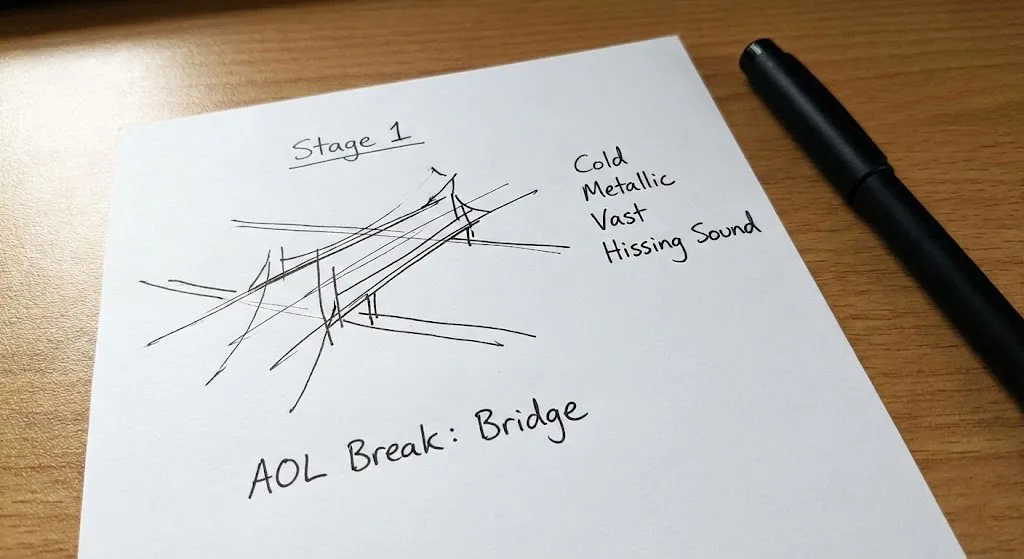
A typical Coordinate Remote Viewing (CRV) ideogram sketch.
How to Practice Remote Viewing: A 5-Step Protocol
If you want to test the boundaries of your own consciousness, you can follow the simplified Coordinate Remote Viewing (CRV) steps. Note that professional training takes years, but these basics will help you understand the mechanism.
- The Cool-Down: Before beginning, you must clear your mind of “AOL” (Analytical Overlay). This is your brain’s tendency to try and guess what the target is. If you think “it’s a bridge,” you are likely wrong. You need to clear that logic to hear the subtle signal.
- The Ideogram: Using a pen and paper, make a quick, spontaneous mark. This is your initial “contact” with the target’s signal line. It looks like a scribble, but to a trained viewer, the pressure and angle of the line contain data.
- Sensory Data Acquisition: Focus on basic textures, colors, and temperatures. Is it cold? Is it metallic? Is it vast? Do not try to name the object. Just describe the raw sensory data flowing into your mind.
- Sketching the Target: Allow your hand to move without your analytical mind interfering. Don’t try to draw a “house”; draw the angles and lines you perceive. If you see a curve, draw a curve. If you feel a jagged edge, draw that.
- The Feedback Loop: The most critical step is Feedback. Once the session is over, you must see the actual target to “loop” the information back to your consciousness. This reinforces the mental connection and trains your brain to recognize the “signal” next time.
The Paradox of Perception
Remote viewing challenges our fundamental understanding of time and space. If a person in a basement in Maryland can describe a submarine in the Pacific, what does that say about the nature of the soul?
It suggests that we are all part of a “non-local” web of information. This concept is explored deeply in The Disclosure Paradox Book 1, where the protagonist uncovers that human consciousness may be the ultimate key to unlocking extraterrestrial mysteries.
Why Remote Viewing Matters Today
In an era of deepfakes, AI, and misinformation, the ability to tap into a non-local “source” of truth is more valuable than ever. The government’s interest in these topics often overlaps with other classified projects, such as the mysteries surrounding underground facilities (See: The Dulce Base Mystery).
Declassified CIA documents have confirmed the efficacy of these programs, yet many remain skeptical. By practicing these protocols, you are engaging in a form of “mental martial arts,” reclaiming the sovereignty of your own perception from official narratives. As we move closer to full transparency regarding government secrets, understanding the potential of the human mind is the first step toward true freedom.